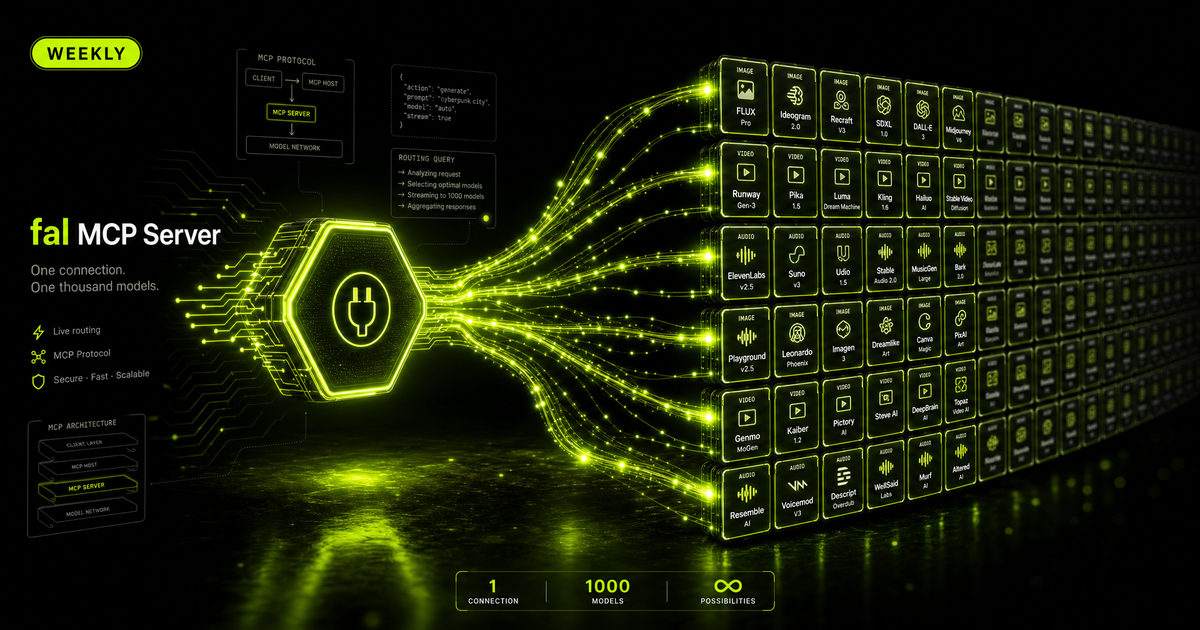
fal MCP Server Connects Any AI to 1K Models
fal just launched the fal MCP Server, a hosted Model Context Protocol endpoint that lets any AI assistant search, run, and chain more than 1,000 generative AI models directly inside a conversation.
The practical upside is real: you point a compatible AI assistant at the fal MCP endpoint and it can call image generators, video models, audio tools, and more without you writing a single line of SDK code or reading a single doc page. One command to connect, then describe what you want in plain language.
For creators who already live inside an AI chat interface, this collapses the gap between ideation and output. Instead of switching tabs to run a separate image model or video tool, you stay in the conversation and chain models together. That kind of composability is where the most interesting creative workflows are heading.
Already on Snippt? Use the image generator to test prompts fast, then route your best outputs through fal's MCP chain for model-to-model refinement. Image Generator →
Midjourney's Thinking Mode Reruns Jobs With Reasoning
Midjourney is testing a new Thinking Mode for image generation on its Alpha site at alpha.midjourney.com, and it works on existing jobs rather than requiring a fresh prompt.
To try it, open any completed job in the lightbox and hit 'Rerun (Thinking)' in the lower right corner. The model reasons through the prompt before committing to pixels, which should tighten the gap between what you asked for and what you actually get on complex or ambiguous prompts.
This is still in testing and Midjourney is actively asking for feedback, so results will vary. The interesting design choice is applying reasoning at the rerun stage rather than the initial generation, which means you can use your existing good prompts as the input and let the thinking layer do the interpretive work.
Generate a base image on Snippt first to nail your concept, then bring your refined prompt to Midjourney's Thinking Mode rerun for the reasoning pass. Image Generator →
Google Ships Universal Gemini Agent for Enterprise
Google announced the Gemini agent at its Gemini at Work event, a cloud-hosted universal agent that can plan multi-step tasks, delegate work to subagents, use multiple AI models, and operate across business apps and systems from a single prompt box.
The agent gets its own workplace identity, including an email address, which means it can participate in workflows the same way a human team member would. It answers questions, does knowledge work, creates media, and writes and runs code, all from one API for developers.
This is enterprise-first for now, available inside the Gemini Enterprise app. Creators working inside larger organizations or building on Google Cloud should watch this closely, because the subagent delegation model is exactly the architecture that makes long, multi-tool creative pipelines possible without babysitting every step.
Liquid AI Drops Open-Weight Decision Models
Liquid AI released Open d1, two open-weight multimodal models in its d1 decision model family: d1-3B, which reads text and images, and d1-omni-600M, which handles text plus image or text plus audio.
Neither model generates text. Both return calibrated, typed answers in a single forward pass with zero output tokens. That architecture makes them very fast and very cheap to run for classification, routing, and decision tasks where you need a structured answer rather than a paragraph.
For creators building tools or pipelines, these models slot in as fast decision layers. Think content moderation, prompt routing, or asset tagging, tasks where you want a confident typed answer in milliseconds rather than a generated explanation.
Anthropic Offers Free Security Scans for Open Source
Anthropic launched OSS Scanner, a free service that runs thorough, periodic security scans on open-source projects using its strongest models at no cost to the project maintainers.
Open-source projects that opt in get proactive vulnerability alerts rather than waiting for a human audit or a breach. Anthropic says the scans are periodic, meaning they run on a schedule rather than just once, so new code paths get reviewed as the project evolves.
If you maintain an open-source AI tool or template that other creators depend on, this is a straightforward win. Opt in, get a stronger security baseline, and reduce the risk that your project becomes the weak link in someone else's pipeline.
What This Week Means for Creators
The through-line this week is composability. fal's MCP Server, Google's subagent architecture, and Liquid AI's decision models all point in the same direction: the next layer of creative productivity comes from chaining specialized models together rather than asking one model to do everything. Midjourney's Thinking Mode fits the same pattern, applying a reasoning pass on top of an existing generation rather than starting from scratch.
The practical move right now is to get comfortable with MCP-compatible tools and start mapping which parts of your workflow are actually decision tasks versus generation tasks. Decision tasks, routing, tagging, approving, are where small fast models like Liquid AI's d1 family will save you real money and time. Generation tasks are where the quality arms race still matters. Knowing the difference is the skill that compounds.
Try These AI Tools Today
From AI video to voice generation, Snippt gives you access to the latest models in one place.
Explore All Tools