Meta Muse Spark Open Runs Locally on Macs
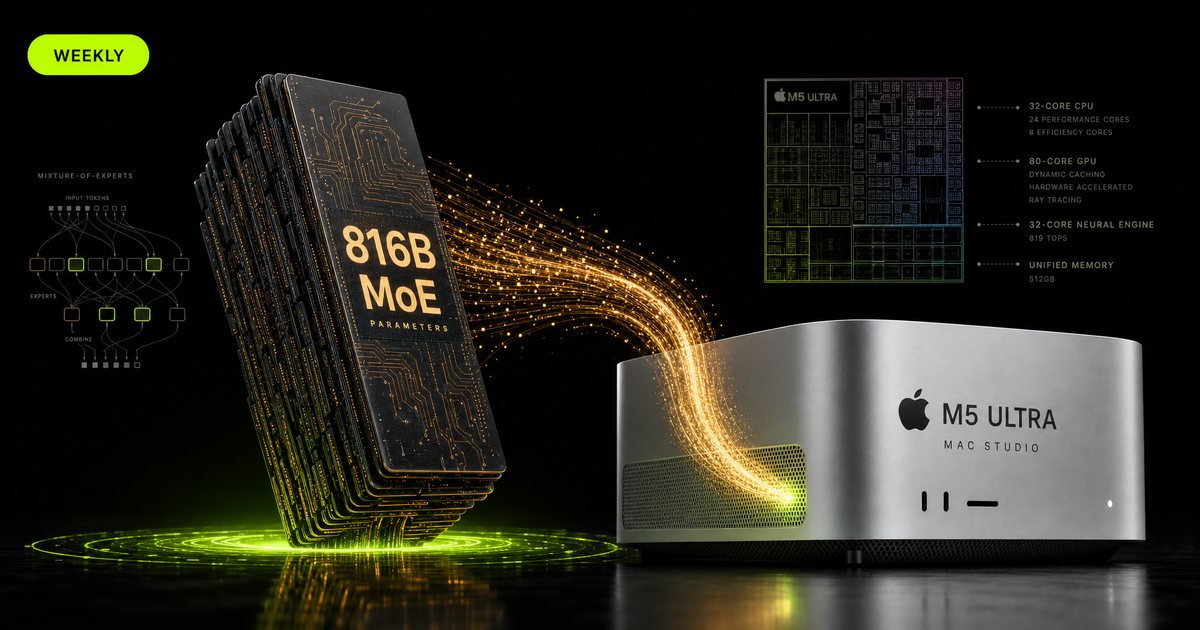
Meta released Muse Spark Open this week, a 816B-parameter mixture-of-experts model with 42B active parameters, and it is optimized to run locally on Apple silicon through MLX. The Verge reports that Meta and Apple worked together specifically to make the model run on M5 Ultra Mac Studios, which is the first time a model at this scale has been positioned for local Mac deployment.
The model is built for coding and agentic work, with particular strength on long-horizon tasks and complex software engineering. If you run a Mac Studio with an M5 Ultra and you have been waiting for a capable open-weight model that does not require a cloud round-trip, this is the one to test first.
The open-weight release means you can fine-tune it, inspect it, and run it without usage restrictions beyond what the license specifies. Meta is calling it the most capable US open-weight model to date, and the benchmark positioning backs that up for agentic and coding tasks.
FLUX.3 Klein Merges Editing and Generation
Black Forest Labs released FLUX.3 Image Klein, a 5.6B open-weights model that handles text-to-image generation, single-reference edits, and multi-reference compositions through a single unified model. The r/LocalLLaMA thread confirms it accepts up to 10 reference images alongside a prompt and returns one output image, with Qwen3-VL-4B-Instruct handling the text understanding side.
The practical win here is that you no longer need to switch between a generation model and a separate inpainting or reference model. Feed it a product photo and a style reference and a text prompt, and it handles the composition in one pass. That cuts a meaningful amount of pipeline complexity for anyone doing product imagery, character consistency work, or style-matched edits.
At 5.6B parameters with open weights, Klein is small enough to run on consumer hardware. If you have been running FLUX.1 locally, this is a direct upgrade path that adds multi-reference capability without a hardware jump.
Try multi-reference image composition right now in Snippt's image generator without any local setup. Image Generator →
Fish Audio Drama 3 Opens 83-Language TTS
Fish Audio released Drama 3, a 35B mixture-of-experts text-to-speech model with roughly 3B active parameters. MarkTechPost reports it accepts plain-language direction, covers 83 languages, and ships under an open-weight community license with a revenue cap.
Plain-language direction is the feature that matters most for creators. Instead of tweaking prosody parameters or SSML tags, you write something like 'say this with exhausted sarcasm' and the model interprets it. That makes Drama 3 genuinely useful for voiceover work, character dialogue, and multilingual content without a prompt engineering detour.
The MoE architecture keeps inference costs down relative to a dense 35B model, and the open weights mean you can fine-tune on your own voice data or specific character profiles. For anyone building a multilingual content pipeline, 83 languages in a single open-weight model is a meaningful consolidation.
Generate expressive voiceover in multiple languages directly inside Snippt's text-to-speech tool. Text to Speech →
NVIDIA Drops 120B Multimodal Agent Model
NVIDIA released Nemotron 3.5 Super VL, a 120B-parameter multimodal mixture-of-experts model with 12B active parameters and a 1M-token context window. MarkTechPost covers the release, noting the model runs on a single DGX Spark using NVFP4 weights, and NVIDIA also shipped two smaller Bolt edge models alongside it.
A 1M-token context window on a model designed for agentic tasks means you can feed it entire codebases, long document sets, or extended conversation histories without chunking. The multimodal capability adds image understanding to that context, which opens up workflows like analyzing a full design system and writing code against it in one session.
The Bolt edge variants are the piece to watch for creators who want local deployment. NVIDIA is clearly building a stack from edge to data center with this release, and the 24GB VRAM target on the Bolt models puts capable multimodal agents within reach of a single high-end consumer GPU.
Grok Voice 3.0 Tops Speech-to-Speech Rankings
SpaceXAI released Grok Voice 3.0, a speech-to-speech model that listens, reasons, calls tools, and responds in voice. MarkTechPost reports it now ranks first on the Artificial Analysis Speech-to-Speech Index with a score of 86.9, ahead of all other models currently on the leaderboard.
The tool-calling capability is what separates this from a standard voice interface. Grok Voice 3.0 can reason mid-conversation and invoke external tools before responding, which means you can build voice agents that actually do things rather than just talk. That is a meaningful step for anyone building voice-first creative or productivity tools.
For creators building interactive audio experiences or voice-driven workflows, a top-ranked model with tool-calling baked in is worth evaluating now. The leaderboard position gives you a concrete quality benchmark to compare against your current setup.
Anthropic Opens Books to Independent Safety Auditors
Anthropic gave METR employee-level access to its systems and, critically, gave up the right to block METR from publishing its findings. TechCrunch reports that METR will publish independent assessments of Anthropic's risks, incidents, and practices without Anthropic having editorial veto power.
For creators who build products on top of foundation models, this kind of third-party auditing with publication rights is the most credible safety signal available. It means the risk assessments you read about Anthropic's models are not filtered through Anthropic's own communications team.
This also sets a precedent that other frontier labs will face pressure to match. If you are choosing between model providers for a production deployment, the presence or absence of independent auditing with real publication rights is now a concrete differentiator to ask about.
What This Week Means for Creators
The through-line this week is capable models moving closer to local and open deployment. Meta's Muse Spark Open on Apple silicon, FLUX.3 Klein on consumer GPUs, Drama 3 with open weights, and NVIDIA's Bolt edge models all point in the same direction: the gap between cloud-only capability and what you can run yourself is closing faster than most people expected six months ago. If you have been waiting to build locally rather than depending on API access, the hardware and model combination is now genuinely viable for serious work.
On the safety side, Anthropic's METR arrangement is the kind of structural accountability that the industry has talked about but rarely implemented. As a creator choosing platforms to build on, independent auditing with no veto rights is a real signal, not a marketing claim. Watch whether other labs follow, and factor the answer into where you put your production workloads.
Try These AI Tools Today
From AI video to voice generation, Snippt gives you access to the latest models in one place.
Explore All Tools