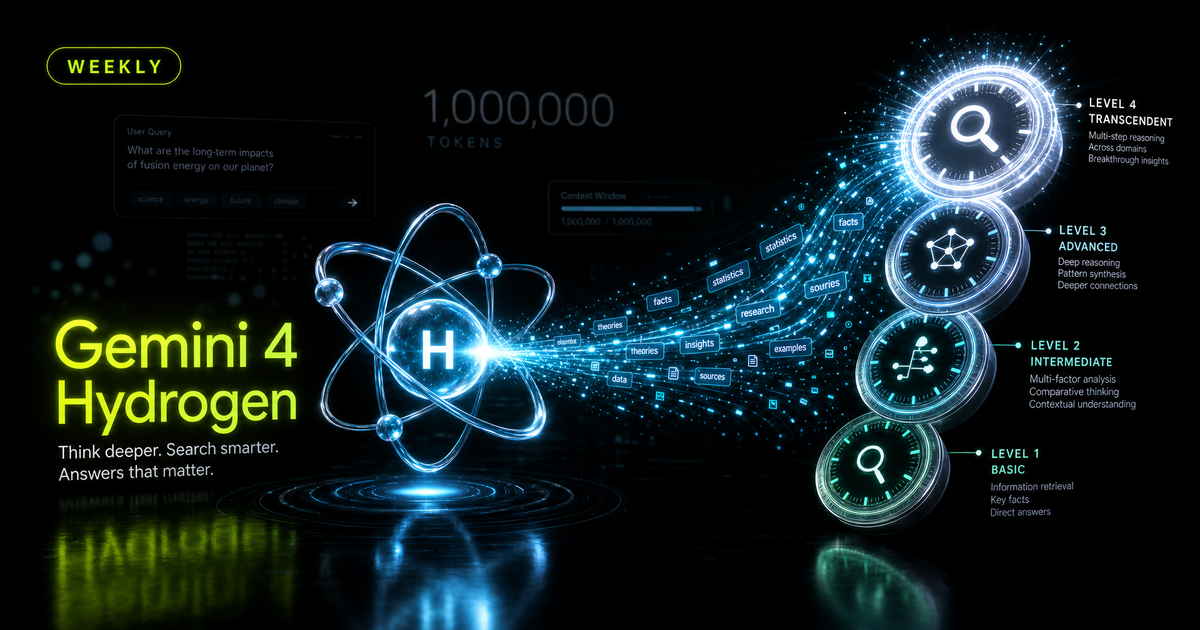
Gemini 4 Hydrogen Arrives in Search Globally
Google has rolled Gemini 4 Hydrogen into Search worldwide, making it the fastest agentic model the company has shipped. It carries a 1M-token context window and four selectable thinking levels, meaning Search can now hold far more context about a query before it answers.
For creators who rely on Search to research briefs, scout competitors, or pull references, the jump in response quality should be immediate and noticeable. Google reports a 51 Artificial Analysis score and a 57% pass rate on Terminal-Bench 4.1, and the model runs 2.5x faster than Gemini 3.8 Flash.
The practical move right now is to test it on the research tasks you currently hand off to other tools. Longer context means you can paste in a full creative brief and get a response that actually accounts for all of it, not just the last paragraph.
H3 Max Beats Every Video Model on Speed and Quality
fal.ai shipped H3 Max, a video generation model that produces a 5-second clip in under 3 seconds. In fal's own human preference evaluations against twelve leading video models, H3 Max ranked first on quality, prompt understanding, and aesthetics. Independent benchmarks from Artificial Analysis and Design Arena confirmed the top ranking.
That speed matters for creators who iterate on video concepts. When a generation takes under 3 seconds, you can test five prompt variations in the time it used to take to render one, which fundamentally changes how you work through a visual idea.
H3 Max was built entirely on fal's own inference and training infrastructure, which is notable because it shows a smaller, focused team can outperform much larger labs on a specific capability when they control the full stack.
Try Snippt's text-to-video tool to generate and compare short clips from your own prompts without leaving the platform. Text to Video →
Jensen Huang Exits Nvidia, Open Source Hangs in the Balance
Jensen Huang has resigned as Nvidia's CEO and co-founder after reports of personal misconduct, leaving the company without the executive who has been its most visible advocate for open-source AI. The Verge has the full account of the circumstances surrounding his departure.
The immediate question for the creator and developer community is what happens to Nvidia's $12.9 billion acquisition of Hugging Face and its public stance against AI export restrictions. Hugging Face CEO Clement Delangue has pledged to keep fighting for open-source AI regardless of what Nvidia's new leadership decides.
For creators who depend on open-weight models for local inference, custom fine-tuning, or cost-sensitive workflows, this transition is worth watching closely. Nvidia's hardware and funding have quietly underpinned a large portion of the open-source model ecosystem, and a shift in corporate priorities could affect which models get resources and which do not.
AI Chatbots Are Sending Shoppers to Fake Sites
A study by IP protection firm Podqi, shared exclusively with The Verge, found that ChatGPT, Gemini, and Perplexity all recommended fake or risky retail websites when prompted with shopping queries. The chatbots cited imposter domains as legitimate places to buy products.
If you are a creator who recommends products to an audience, this is a trust problem that lands on you. A viewer who follows your advice, searches the product in an AI chatbot, and ends up on a scam site will blame you before they blame the chatbot. Linking directly to verified retailers in your content is now a basic safety practice, not just good housekeeping.
The broader issue is that AI shopping citations are not verified the way traditional search results are filtered over time. Until the major chatbot providers add real-time domain reputation checks to their citation pipelines, treat AI-generated shopping links as unverified by default.
Adobe and Google Merge Creative and Productivity Tools
Google and Adobe announced a deeper integration that brings their tools into each other's workflows. The partnership lets users edit PDFs directly inside Google Drive and access Adobe AI tools from within Gemini.
For creators who already live in both ecosystems, this removes a constant context switch. Editing a client PDF, pulling a Gemini-generated draft into an Adobe layout, or running Adobe AI on an asset without leaving your Google Workspace session are all now part of the same surface.
The practical test is whether the integrations run at full feature depth or are trimmed versions that push you back to the native app for anything serious. Worth opening a PDF in Drive and running through your usual edits before deciding whether this changes your actual workflow.
While you wait to test the Adobe-Google pipeline, Snippt's background remover handles clean cutouts for assets you are already editing. Background Remover →
What This Week Means for Creators
Two things accelerated this week that directly affect how fast you can produce work. Gemini 4 Hydrogen brings a genuinely faster, context-aware model into the search tool most creators already use every day, and H3 Max sets a new floor for video generation speed. When a 5-second clip renders in under 3 seconds, iteration stops being a bottleneck and becomes part of the creative process itself.
The Nvidia leadership story is slower-moving but carries more long-term weight. The open-source model ecosystem that powers local inference, affordable fine-tuning, and independent tooling has depended on Nvidia's backing in ways that were not always visible. Watch who Nvidia installs as the next CEO and how quickly they signal a position on the Hugging Face acquisition. That decision will shape which tools remain viable for independent creators over the next few years.
Try These AI Tools Today
From AI video to voice generation, Snippt gives you access to the latest models in one place.
Explore All Tools